
On paper, learning how to wash your face seems trivial — squeeze out cleanser, massage it in, rinse. Yet the choices you make during that single minute either prime your skin for everything that follows or chip away at your barrier in ways that stack up over time. Water that’s too hot, hands pressing too hard, a mismatched cleanser, washing too often — minor habits, outsized results.
Below is how to wash your face correctly for any skin type, the mistakes that trip up most people, and the reasoning behind why every step earns its place.
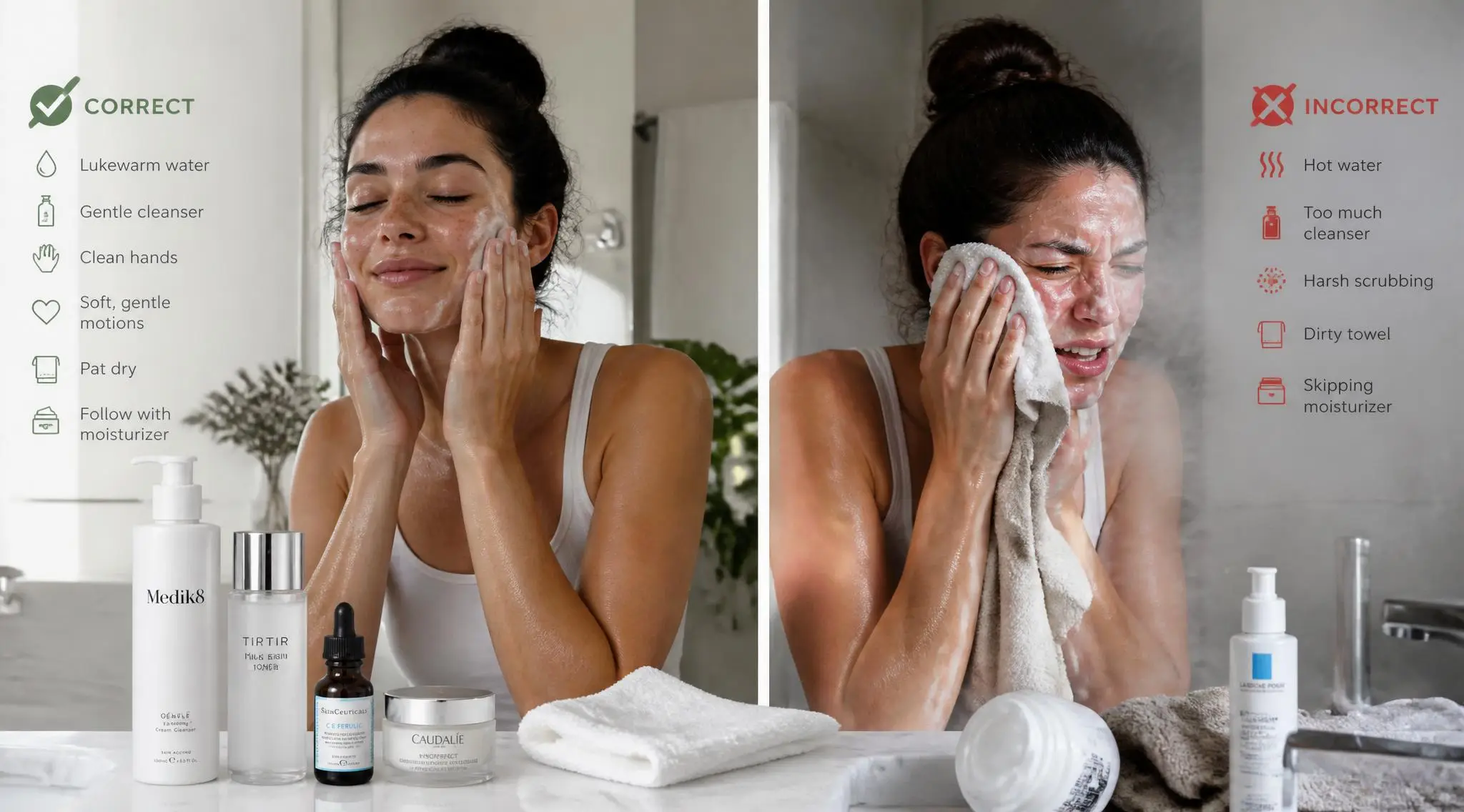
The short answer: The right way to wash your face is twice daily (oily skin) or once daily (dry skin), with lukewarm water and a gentle sulfate-free cleanser. Wash for 30–60 seconds with circular fingertip motions, never with hot water or rough scrubbing. Pat dry — don’t rub — and apply your moisturizer within 60 seconds while skin is still slightly damp.
Why How You Wash Your Face Matters as Much as What You Use
Your cleansing technique produces real, measurable changes in your skin barrier. Every factor listed below either protects or breaks down the lipids that bind your stratum corneum together:
- Water temperature — hot water pulls lipids out faster than lukewarm or cool water
- Cleanser pH — anything alkaline (above pH 7) throws off the skin’s acid mantle
- Surfactant chemistry — sulfates latch onto skin proteins; amino-acid surfactants leave them alone
- Contact time — too brief and nothing gets clean; too long and you over-cleanse
- Mechanical force — scrubbing causes microtears and ongoing inflammation
- Drying method — dragging a coarse towel across your face takes off more than water alone
Get it right and how to wash your face becomes the groundwork that lets your serums and moisturizer sink in properly. Get it wrong and you manufacture the exact issues your routine was meant to solve.
The 7 Steps: How to Wash Your Face Properly
Step 1 — Wash your hands first
Your hands have been in contact with countless surfaces all day. Moving from dirty hands straight to your face is the quickest route for bacteria to reach your pores. Give them a 20-second scrub with ordinary soap before you begin.
Step 2 — Use lukewarm water
Hot water is satisfying — and it wrecks your skin barrier. On top of that, it widens capillaries, which can aggravate rosacea and leave your face flushed after cleansing. Cold water, meanwhile, is too mild to break down oil and grime properly. Shoot for something like a tepid bath — pleasant against the skin, never steaming.
Step 3 — Wet your face thoroughly
Spread a handful of splashes evenly over your face and neck. This lifts loose surface debris and lays down a foundation for the cleanser to do its job.
Step 4 — Apply cleanser the right way
With most cleansers, squeeze out a nickel-sized amount onto your fingertips, add a few drops of water to build a soft lather, then spread it across your face. Move in small circles using only your fingertips — keep your palms off and your nails away. Reach everywhere: forehead, nose, cheeks, jawline, chin, neck.
Time: 30–60 seconds. Research points to this window as the contact time that gets skin clean while keeping barrier disruption to a minimum. Under 30 seconds and the cleaning is superficial; over 60 seconds and you’ve tipped into over-cleansing.
Step 5 — Rinse thoroughly
Switch back to lukewarm water and splash 8–10 times, or keep going until not a trace of cleanser remains. The hairline, jawline, and the creases beside your nose are where people leave residue behind — give those zones extra care. Leftover cleanser is a frequent trigger for breakouts and irritation.
Step 6 — Pat dry with a clean towel
Reach for a clean, soft towel reserved only for your face — towels pass bacteria around quickly. Pat lightly instead of rubbing. Stop while your skin is still a little damp; that’s what helps the next step absorb best.
Step 7 — Apply moisturizer within 60 seconds
Water evaporates from your skin fast in the moments after washing. Getting moisturizer (plus any other steps) on within 60 seconds of drying seals in the most hydration. That one habit moves the needle more than which moisturizer brand you reach for.
How to Wash Your Face by Skin Type
| Skin type | Morning | Evening | Notes |
|---|---|---|---|
| Oily/acne-prone | Gentle gel cleanser | Double cleanse if SPF/makeup | Avoid foaming sulfates |
| Dry | Water rinse or cream cleanser | Cream or oil cleanser | Skip morning wash if very dry |
| Combination | Gentle gel | Gel or oil-balm | Vary by season |
| Sensitive | Water only or non-foaming cream | Non-foaming cream cleanser | Fragrance-free, glucoside-based |
| Mature | Cream cleanser | Cream or oil-balm | Preserve lipids; never bar soap |
| Mixed acne + sensitive | Water rinse | Gentle amino-acid cleanser | Skip salicylic acid wash; use serum instead |
The Double Cleanse, Demystified
Double cleansing — running two separate cleansers back to back — crossed over from Korean skincare into everyday Western routines, and plenty of people are fuzzy on when it earns its keep. Here’s where it genuinely helps:
When to double cleanse
- At the end of a day you wore SPF (water-resistant formulas resist a water-based cleanser on their own)
- At the end of a day you wore makeup, particularly long-wear or waterproof types
- After hours in heavy pollution or an obviously grimy setting
When NOT to double cleanse
- In the morning (there’s no need)
- On days with no SPF or makeup (one cleanse covers it)
- When your skin is very dry, sensitive, or already compromised
How to double cleanse
- First cleanse: work an oil-based balm or oil cleanser into dry skin to break down oil-soluble residue. Drop in a little water to emulsify, then rinse off.
- Second cleanse: follow with a water-based cleanser to clear whatever the oil left behind. Cleanse for 30–60 seconds and rinse with lukewarm water.
For help picking the right cleansers, take a look at our face wash guide.
What Most People Get Wrong About How to Wash Your Face
Hot water (especially in the shower)
The shower is the worst spot to clean your face, since the water tends to run far hotter than you’d want. Hot water plus steam does a number on your barrier. If the shower is where you wash your face, dial the heat down or rinse your face on its own once you’re out.
Bar soap on the face
Classic bar soap (sodium tallowate or sodium cocoate) sits on the alkaline end — frequently pH 9–10 — and throws off your acid mantle. Syndet bars are another animal entirely: synthetic detergent bars built at a lower pH with gentler surfactants, and they can be fine. Check the label — if you spot tallow or saponified oils, you’re holding traditional soap.
Cleansing brushes and tools
Spinning brushes (the Clarisonic kind), daily-use Konjac sponges, and silicone cleansing gadgets had a solid decade of popularity. The prevailing view in dermatology now is that they tend to over-cleanse most skin types and can wear down the barrier with routine use. Your fingertips are perfectly capable.
Cleansing for too long
Going past 60 seconds won’t leave your skin any cleaner — it only strips off more lipids. When you feel the urge to scrub harder or longer, the cleanser is usually the culprit, not your technique.
Using the same towel for body and face
Body towels are bacteria magnets. Keep a separate face cloth and swap it out every 2–3 days.
Going straight to bed without washing
This is the worst skincare habit there is. Sebum, sunscreen, makeup, and a day’s worth of pollution left to sit on your face overnight is a blueprint for breakouts and dull skin. Cleanse before bed, every time.
Special Situations: How to Wash Your Face in Edge Cases
If you have rosacea
Stick to lukewarm water (not warm), a gentle non-foaming cream cleanser, no rubbing or scrubbing at all, and a pat dry. Hot water and friction rank among the biggest rosacea triggers.
If you’re prone to under-eye irritation
Cleanse the rest of your face first, then ease very gently over the eye area at the very end with the lightest touch. Steer clear of soap-based or heavy-foam cleansers near the eyes.
If you wore heavy makeup
Start with a balm or oil cleanser to lift makeup gently, especially around the eyes. Cotton pads with micellar water are fine for targeted removal but shouldn’t stand in for an actual cleanse.
If you have facial hair
With a beard or mustache, your cleanser still has to make it to the skin below. Massage it down through the hair to the skin, then rinse well so no residue lingers.
If you sweat heavily during workouts
A plain water rinse right after exercise usually does the trick — you don’t need a full cleanse every single time. Sweat on its own won’t hurt your skin, but mixed with sebum and bacteria and left sitting, it can spark breakouts.
How to Tell If You’re Over-Cleansing
Telltale signs your washing routine is too harsh:
- Tightness the moment you rinse off (that “squeaky clean” feel)
- Flaking, peeling, or dryness that won’t quit
- More oil, not less (counterintuitive but real)
- Stinging when you put on serums or moisturizer
- Low-level redness that lingers
- Fresh breakouts in spots you don’t normally get them
To turn it around: move to a milder cleanser (amino-acid or glucoside-based), drop to washing once a day rather than twice, stick to lukewarm water only, and layer on a barrier-supportive moisturizer the moment you finish.
Vegan Cleansers to Look For
The surfactants in most modern cleansers are either plant-based or synthetic. These are the animal-derived ingredients worth scanning for:
- Sodium tallowate — rendered animal fat (a staple in bar soaps)
- Honey, royal jelly, propolis — tossed in for “soothing” marketing
- Milk proteins / casein / lactose — found in milk cleansers
- Lanolin — turns up now and then in cream cleansers
- Silk amino acids — sourced from silkworms
For a deeper look at vegan cleansers and ingredient swaps, check our vegan skin care line guide.
Frequently Asked Questions About How to Wash Your Face
How often should I wash my face?
For most skin types, twice daily (morning and night); for dry or compromised skin, once is enough. Over-washing ranks among the leading reasons skin turns “sensitive.” A tight feeling after cleansing means you’re washing too frequently or with the wrong product.
What temperature water should I use to wash my face?
Lukewarm — pleasant to the touch, neither steaming nor cold. Hot water strips away your skin’s own lipids and can flare up redness, rosacea, and barrier problems. Cold water can’t break down oils well, so it leaves your face under-cleaned. Lukewarm hits the sweet spot.
Should I use a washcloth or my hands to wash my face?
Your hands beat a washcloth for everyday cleansing. Washcloths collect bacteria and can be too rough for sensitive skin. If you’d rather use one, pick a soft muslin cloth, change it daily, and keep the pressure light — no scrubbing.
Is it okay to wash my face in the shower?
Yes, with one caveat: shower water usually runs too hot for your face. Either lower the temperature before you wash, or rinse your face separately with lukewarm water after you step out. Hot water and steam together are tougher on your barrier than most people assume.
How long should I wash my face?
30–60 seconds. Anything under 30 seconds doesn’t give the cleanser time to break down sebum and dirt. Anything over 60 seconds begins stripping your natural lipids for no reason. Time yourself for a week if you’re unsure — most people default to either 10 seconds or a full 2 minutes.
Should I wash my face after working out?
A water rinse right after exercise is usually plenty. You don’t need a product-based cleanse every time. The exception is wearing makeup or heavy SPF during the workout — then a gentle cleanse earns its place. Sweat by itself is harmless, but leaving it on for hours can feed breakouts.
Do I need to wash my face in the morning if I cleansed at night?
For dry or sensitive skin, often not — a water rinse covers it. For oily or combination skin, a gentle morning cleanse usually pays off, since sebum and sweat build up overnight. Test both for a fortnight each and judge which leaves your skin happier.
The Bottom Line on How to Wash Your Face
Knowing how to wash your face is a 60-second skill with an outsized impact on your skin’s long-term health. Lukewarm water, a gentle cleanser suited to your skin type, 30–60 seconds of contact, a complete rinse, and a pat dry with a clean towel — that’s the whole method. Slide your moisturizer on within 60 seconds of drying to trap the hydration. The fundamentals done day in and day out beat any high-tech device or fashionable multi-step ritual.
Sources & Further Reading
- American Academy of Dermatology — Face Washing 101
- Role of pH in Skin Cleansing (Int J Cosmet Sci, 2021)
- Polymeric Surfactant Cleanser for Sensitive Skin (J Drugs Dermatol, 2024)
- Soap-free cleansing lotion clinical evaluation (Cureus, 2025)
Last updated: May 22, 2026. For informational purposes only — not a substitute for professional dermatological advice.