
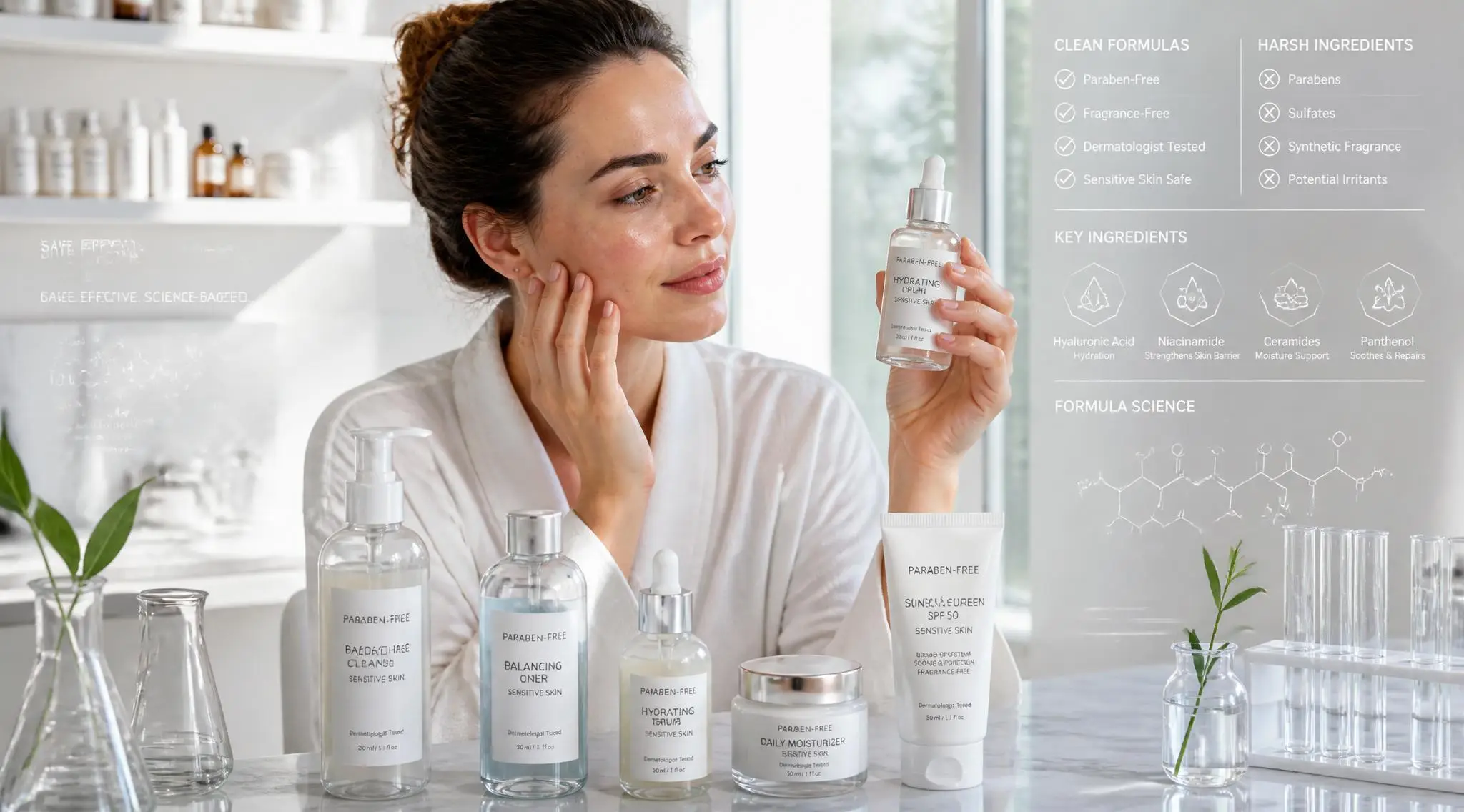
Few labels travel as widely across clean beauty as “paraben-free skincare” — yet the reasons parabens fell out of favor are messier than any product front-of-pack ever admits. Depending on who you ask, they’re either perfectly fine at the doses used in cosmetics or quietly worth worrying about: regulators tend toward the former view, advocacy groups toward the latter. Reality lands between those poles, and understanding where helps you pick paraben-free skincare that genuinely outperforms the conventional version rather than simply wearing different packaging.
What follows is an even-handed breakdown of the parabens debate, the ingredients now standing in for them, and how to assemble a paraben-free skincare routine that actually works.
The short answer: Parabens are preservatives that stop bacteria and fungi from taking hold in skincare. The big regulatory authorities (FDA, European Commission, ACDS) rate them safe at cosmetic concentrations, yet shopper preference has pushed the industry toward substitutes anyway. The usual stand-ins — phenoxyethanol, sodium benzoate, leucidal liquid (radish root ferment) — do the job well when a formula is built properly. Going paraben-free doesn’t make a product inherently “cleaner” or safer, but it’s a values-driven pick, particularly if you lean toward plant-based options.
What Parabens Actually Are
Chemically speaking, parabens are esters derived from p-hydroxybenzoic acid, and cosmetics have relied on them as preservatives for more than a hundred years. Their strength lies in shutting down bacterial and fungal contamination — a non-negotiable for product safety, since an unpreserved formula can turn into a microbial breeding ground within days of being opened and trigger genuine skin infections.
The parabens you’ll run into most often:
- Methylparaben — the workhorse of the group; very weak estrogenic activity
- Ethylparaben — runner-up in frequency; very weak estrogenic activity
- Propylparaben — moderate estrogenic activity
- Butylparaben — moderate estrogenic activity; subject to limits in certain markets
- Isobutylparaben, isopropylparaben — prohibited in the EU; dropped voluntarily across many regions
The Science Behind Paraben-Free Skincare
The whole controversy traces back to a 2004 study that found parabens present in samples of breast cancer tissue. That paper never compared the findings against healthy tissue, never demonstrated that parabens triggered the cancer, and never weighed the measured amounts against ordinary exposure — but the headlines alone sparked a backlash lasting decades, and that backlash is what turned paraben-free skincare into its own product category.
The research that came afterward has been far more careful, and it paints a more layered picture. A 2024 literature review in CosmoDerma points out that even amid the uproar, the American Contact Dermatitis Society named parabens its “non-allergen of the year” in 2019 — their rate of provoking allergic reactions is strikingly low (0.6% in patch testing at 12% concentrations) next to most other preservatives.
Here’s what the evidence actually supports:
- Parabens can attach weakly to estrogen receptors. Still, at the levels relevant to cosmetic use, that binding runs 10,000–170,000 times feebler than the body’s own estrogen.
- The body clears parabens quickly. They’re broken down and flushed out without building up to any meaningful degree.
- Regulators continue to judge them safe at standard levels. The FDA, European Commission, and Health Canada all green-light methyl- and ethylparaben in cosmetics up to 0.4% individually and 0.8% in combination.
- The longer-chain versions have been reined in. Isopropylparaben, isobutylparaben, phenylparaben, benzylparaben, and pentylparaben are all barred in the EU.
- Swapping in a substitute isn’t a guaranteed upgrade. Certain replacements (methylisothiazolinone, formaldehyde-releasing preservatives) provoke allergies more often than parabens do.
Why Consumers Choose Paraben-Free Skincare Anyway
The data may be murky, but appetite for paraben-free skincare hasn’t faded — and several of the motivations behind it are perfectly sound:
- Caution by default. For some people, even faint endocrine activity is reason enough to skip something they’d otherwise apply every day for a lifetime.
- Ecological worries. Parabens have turned up in marine environments and could have effects on aquatic organisms.
- Personal principles. Vegan and natural-living mindsets tend to favor plant-sourced preservatives over synthetic ones.
- Individual reactions. A subset of people genuinely react to particular parabens, and moving to alternatives can clear up stubborn irritation.
- Particular health situations. Those managing hormone-sensitive conditions sometimes opt, as a precaution, to limit anything that mimics estrogen.
None of these reasons are unreasonable. What matters is selecting paraben-free skincare built on well-validated alternatives rather than preservatives that merely sound natural while delivering weaker protection or higher allergy risk.
Common Paraben Alternatives in Modern Skincare
| Preservative | Source | Effectiveness | Notes |
|---|---|---|---|
| Phenoxyethanol | Synthetic (found naturally in green tea) | Strong | The go-to choice; capped at 1% in the EU |
| Sodium benzoate | Synthetic; salt of benzoic acid | Moderate | Works at acidic pH; food-grade safe |
| Potassium sorbate | Synthetic; salt of sorbic acid | Moderate | Frequently combined with sodium benzoate |
| Leucidal liquid (radish root ferment) | Fermented from radish | Moderate | A favorite of “all-natural” brands |
| Caprylyl glycol, ethylhexylglycerin | Synthetic | Moderate (preservative boosters) | Commonly deployed together |
| Benzyl alcohol | Naturally occurring | Moderate | May irritate certain users |
| Sodium dehydroacetate | Synthetic | Moderate | Cleared for use in both the EU and US |
| Methylisothiazolinone (MIT) | Synthetic | Strong | Elevated allergy rate; steer clear if your skin is sensitive |
How to Build a Paraben-Free Skincare Routine
A full paraben-free skincare routine looks no different in shape from any standard one:
Morning
- Gentle cleanser — paraben-free and sulfate-free; preserved with phenoxyethanol or sodium benzoate
- Vitamin C serum — usually self-preserving thanks to its low pH; go for stabilized formulas
- Niacinamide serum
- Moisturizer — paraben-free, ideally with ceramides, niacinamide, and humectants
- Mineral or modern chemical SPF 30+ — plenty of vegan-leaning brands carry paraben-free SPF
Evening
- Oil or balm cleanser (often self-preserving by nature)
- Gentle water-based cleanser
- Treatment serum (niacinamide, peptides, or a hydrator)
- Retinoid every other night (see our retinaldehyde vs retinol guide)
- Rich paraben-free moisturizer with ceramides
For a deeper walk-through of building an entire natural routine, head to our complete skin care routine guide.
How to Read a Paraben-Free Skincare Label Correctly
The “paraben-free” badge on the front is only your opening filter. Confirm it by working through the entire ingredient list:
Parabens show up under names like:
- Methylparaben
- Ethylparaben
- Propylparaben
- Butylparaben
- Anything that ends in “-paraben”
Preservatives you’ll typically find in legitimate paraben-free skincare:
- Phenoxyethanol (frequently teamed with caprylyl glycol)
- Sodium benzoate
- Potassium sorbate
- Leuconostoc/radish root ferment filtrate (leucidal liquid)
- Glyceryl caprylate
- Pentylene glycol
Spotting these means the product is truly paraben-free:
- Not a single “-paraben” ingredient anywhere on the list
- One or more of the substitutes above doing the preserving
What Paraben-Free Skincare Doesn’t Automatically Mean
It pays to be precise about the things “paraben-free” does not promise:
- It isn’t automatically vegan. A paraben-free formula might still include lanolin, beeswax, or honey. Verify that separately.
- It isn’t automatically fragrance-free. Fragrance (parfum) ranks among the most frequent irritants, and it has nothing to do with parabens.
- It isn’t automatically cruelty-free. Animal testing is its own issue — look for Leaping Bunny, PETA, or The Vegan Society certification.
- It isn’t automatically “clean” or “natural.” Paraben-free products can still carry synthetic ingredients, contentious preservatives such as methylisothiazolinone, or other compounds you’d prefer to skip.
- It isn’t automatically effective. A paraben-free product performs only if it’s formulated well — the remainder of the ingredient list decides that.
The Most Common Paraben-Free Skincare Mistakes
1. Equating paraben-free with safer. A handful of substitutes (methylisothiazolinone, formaldehyde-releasers) trigger allergies more readily than parabens. Always read the whole ingredient list.
2. Reaching for unpreserved products. “Preservative-free” formulas come with genuine contamination dangers. A paraben-free product backed by a proven alternative beats one with no preservation at all.
3. Making DIY skincare with no preservation. Home-brewed products lacking preservatives can sprout harmful microbes inside a few days. If you make your own, build in a proper preservative system.
4. Taking “natural” preservatives on faith. Natural preservation can succeed with the right components (leucidal liquid, sodium benzoate at the correct pH), but some “natural” claims paper over thin protection that simply doesn’t hold.
5. Disregarding shelf life. Paraben-free products often last less long than conventional ones, so honor the period-after-opening (PAO) symbol.
Genuinely Vegan + Paraben-Free Skincare
If you want skincare that lines up with your values, aim for all three at once:
- Paraben-free — confirmed by checking the ingredient list yourself
- Vegan — certified by The Vegan Society or PETA
- Cruelty-free — certified by Leaping Bunny
Together, that trio sits squarely at the intersection of clean-beauty principles and animal welfare. For more guidance on putting a vegan routine together, see our vegan skin care line guide.
Frequently Asked Questions About Paraben-Free Skincare
Do parabens actually pose a danger?
At the levels cosmetics use (generally 0.01–0.3%), the leading regulators — the FDA and European Commission among them — rate parabens safe. They can mimic estrogen faintly, but with potency more than 10,000 times below the body’s natural estrogen. A few long-chain types (isobutylparaben, isopropylparaben) have been limited or banned. Ultimately, choosing paraben-free skincare comes down to personal values far more than any clear safety verdict.
Is paraben-free skincare always the safer option?
Not by default. Some replacements — methylisothiazolinone (MIT), methylchloroisothiazolinone (MCI), and formaldehyde-releasing preservatives — carry higher allergy and irritation rates than parabens. Phenoxyethanol, sodium benzoate, and naturally derived options like leucidal liquid are usually well tolerated. Read the complete ingredient list instead of relying on the “paraben-free” claim by itself.
Which paraben substitute is used most?
Phenoxyethanol leads by a wide margin, often combined with caprylyl glycol or ethylhexylglycerin as a “preservative booster.” It performs at standard cosmetic concentrations, is capped at 1% in the EU, and is generally well tolerated. Certain “all-natural” brands lean instead on fermented options like radish root ferment (leucidal liquid).
Can I make paraben-free skincare myself?
You can, with some important caveats. Homemade products that lack proper preservation can grow harmful microbes within days. If you go the DIY route, use a validated natural preservative system (leucidal liquid paired with sodium benzoate, say), or mix tiny batches and keep them refrigerated for short-term use only. A certified paraben-free commercial product is the safer, more dependable bet.
Does paraben-free skincare go off sooner?
It can. Many natural preservatives are a touch less robust than parabens at holding off microbial contamination. Watch the period-after-opening (PAO) symbol on the packaging — typically 6–12 months for paraben-free products versus 12–24 months for conventional ones.
Should I steer clear of all preservatives, not just parabens?
No. Preservatives are vital for product safety — strip them out and your skincare would breed bacteria, fungi, and mold within days of opening. “Preservative-free” products are a real contamination hazard. The goal is to pick well-tolerated preservatives, not to do without them.
Are paraben-free skincare and “clean beauty” one and the same?
Not quite. “Clean beauty” is an unregulated marketing phrase, usually pointing to formulas that leave out certain ingredients (parabens, sulfates, synthetic fragrance, and so on) with no shared definition from brand to brand. Paraben-free, by contrast, is a specific claim you can verify. Trust full ingredient lists rather than “clean” labeling.
The Bottom Line on Paraben-Free Skincare
Opting for paraben-free skincare is a values-driven decision that can also perform beautifully on a clinical level — provided the alternatives are chosen wisely. The strongest paraben-free products lean on proven substitutes (phenoxyethanol, sodium benzoate, leucidal liquid) and back that preservative system with capable actives, mild surfactants, and barrier-supporting ingredients. Think of “paraben-free” as just one filter in your toolkit — layer it with vegan, cruelty-free, and evidence-backed actives, and you’ll end up with a routine that honors your values without sacrificing results.
Sources & Further Reading
- Understanding Parabens — A Literature Review (CosmoDerma, 2024)
- Controversy Around Parabens: Alternative Preservatives (PubMed)
- Preservatives in Skin Care — Skin Type Solutions Analysis
- FDA — Parabens in Cosmetics
Last updated: May 22, 2026. For informational purposes only — not a substitute for professional medical advice. If you suspect a preservative allergy, consider patch testing with a dermatologist.