

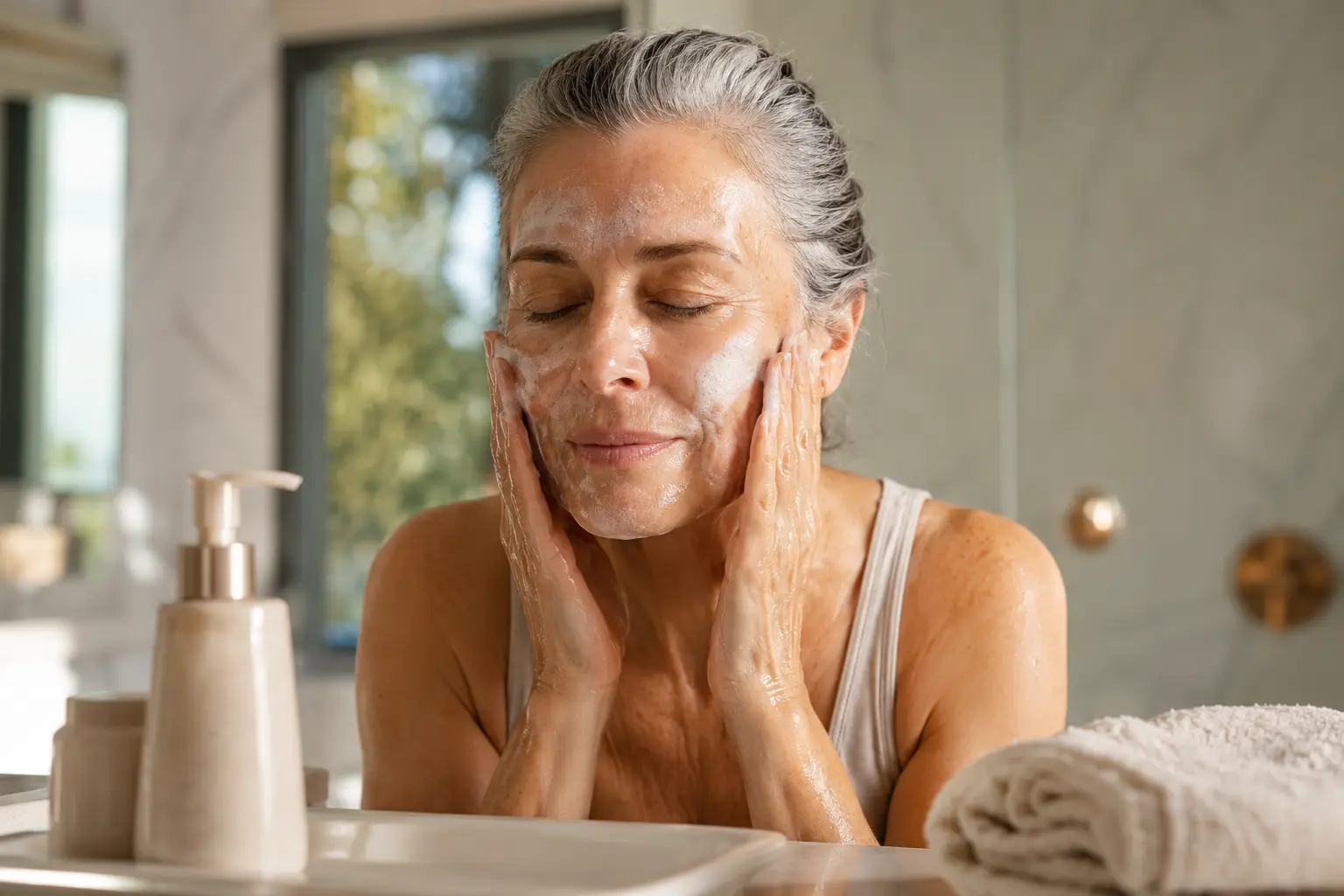
The face wash that worked in your 20s probably isn’t the one your skin needs in your 40s and beyond. Mature skin produces less natural oil, has a thinner barrier, and shows damage from harsh cleansers faster than younger skin. The wrong face wash can quietly undo months of anti-aging work in your serums and creams — strip the lipids your barrier needs, and even the best retinoid in the world will struggle to deliver results.
Here’s how to choose the best face wash for aging skin, the ingredients that support a mature barrier, and the cleansing mistakes that accelerate visible aging.
The short answer: The best face wash for aging skin is a non-foaming or low-foaming cream, oil, or amino-acid-based cleanser at pH 4.5–5.5 that removes dirt and makeup without stripping your skin’s lipid barrier. Look for added humectants (glycerin), ceramides, niacinamide, and antioxidants. Avoid sulfates (SLS, ALS), bar soaps, and high-foam cleansers — they accelerate barrier breakdown that’s already happening with age.
How Mature Skin Differs From Younger Skin
Skin changes substantially over decades. By your 40s and 50s, several shifts have happened:
- Sebum production drops. Less natural oil means a less robust barrier and more visible dryness.
- Cell turnover slows. Dead cells accumulate longer on the surface, creating dullness and rough texture.
- Lipid composition changes. Ceramide levels in the stratum corneum decline, weakening the barrier.
- Collagen and elastin loss accelerate. Skin loses some of its bounce and structural support.
- pH shifts slightly upward. Mature skin tends toward less acidic — making it more vulnerable to harsh cleansers.
- Healing slows. Irritation from over-cleansing takes longer to resolve.
The cleanser appropriate for these changes is different from what works for 25-year-old skin. Foaming sulfate cleansers — fine for oily young skin — strip the already-depleted lipids in mature skin, accelerating visible signs of aging.
What to Look for in a Face Wash for Aging Skin
Surfactant type
Choose milder surfactants that don’t disrupt the lipid barrier:
- Amino-acid-based (sodium cocoyl glycinate, sodium cocoyl apple amino acids, sodium methyl cocoyl taurate)
- Non-ionic glucosides (coco-glucoside, decyl glucoside, lauryl glucoside)
- Cream/lotion cleansers with no surfactants at all
- Oil cleansers and cleansing balms for double-cleansing or as standalone
Avoid sulfates: sodium lauryl sulfate (SLS), ammonium lauryl sulfate (ALS), sodium laureth sulfate (SLES — slightly milder but still strips).
pH
Look for cleansers in the pH 4.5–5.5 range. Mature skin tolerates alkaline cleansers worse than younger skin. Traditional bar soaps (pH 9–10) are particularly damaging.
Supportive ingredients
The best face washes for aging skin add ingredients that work during the brief contact time:
- Glycerin — humectant; counters the drying effect of cleansing
- Ceramides — replace lipids the cleanser might strip
- Niacinamide — supports barrier and reduces redness
- Panthenol (vitamin B5) — soothing and hydrating
- Antioxidants (vitamin E, green tea, resveratrol) — defend against free radicals
- Hyaluronic acid — humectant
- Peptides — supportive (limited contact time, but they don’t hurt)
What to avoid
- Sulfates (SLS, ALS) — strip lipids and proteins
- Denatured alcohol high on the ingredient list — drying
- Fragrance (parfum) — common irritant; mature skin is more reactive
- Essential oils at high concentrations — irritants
- Strong physical exfoliants (walnut shell, apricot pit, rough particles) — cause microtears
- Strong AHAs/BHAs in cleanser form for daily use — short contact time, but daily exposure adds up
Comparison Table: Cleanser Types for Aging Skin
| Type | Best for | Pros | Cons |
|---|---|---|---|
| Cream cleanser | Dry mature skin | Preserves lipids; gentle | May not remove heavy makeup alone |
| Oil/balm cleanser | Removing SPF/makeup | Dissolves oil-soluble residue gently | Often needs follow-up rinse |
| Amino-acid foam | Combination mature skin | Mild lather; pH-balanced | Pricier than sulfate-based foams |
| Micellar water | Quick cleanse; sensitive skin | No rinsing needed (sometimes) | Doesn’t fully remove water-resistant SPF |
| Glucoside-based gel | Oily mature skin | Cleans without stripping | Less foam (some find unsatisfying) |
| Bar soap | Generally avoid for mature face | Cheap | Alkaline; strips lipids |
The Right Way to Cleanse Mature Skin
How you cleanse matters as much as what you use. For mature skin specifically:
- Lukewarm water only. Hot water strips already-depleted lipids faster. Cold water doesn’t dissolve sebum and SPF effectively.
- Pre-cleanse with oil or balm at night. The first cleanse dissolves SPF and makeup gently. Skip the foaming step if it leaves skin feeling tight.
- Massage gently for 30–60 seconds. Don’t scrub. Use circular fingertip motions only.
- Rinse thoroughly. Residual cleanser causes irritation. Pay extra attention to hairline, jaw, and sides of nose.
- Pat dry, never rub. Aging skin is more easily damaged by friction. Use a clean soft towel.
- Apply hydrating serum within 60 seconds. Mature skin loses water faster after cleansing.
For the complete step-by-step technique, see our steps to washing your face guide.
Morning vs Evening Cleansing for Mature Skin
Morning
For most mature skin, a water rinse or very gentle cream cleanser in the morning is enough. The moisturizer from the night before doesn’t need to be stripped. If your skin feels comfortable, a water-only rinse is often best.
Evening
A more thorough cleanse is appropriate at night to remove the day’s accumulation:
- If you wore SPF or makeup: oil cleanser first, then a gentle gel or cream cleanser (a “double cleanse”)
- If you didn’t wear SPF or makeup: a single cleanse with a cream or amino-acid cleanser is fine
How a Good Cleanser Supports the Rest of Your Anti-Aging Routine
Most anti-aging products (retinoids, peptides, vitamin C, niacinamide) work better on a healthy skin barrier. A harsh cleanser that strips your barrier:
- Reduces the effectiveness of every product applied after it
- Increases irritation from active ingredients like retinoids
- Slows the healing your evening routine is supposed to support
- Compounds dryness, dullness, and visible fine lines
The cleanser is the foundation. Get it wrong and even the best $200 serum struggles to deliver. Get it right and a $25 retinol cream performs significantly better.
Special Considerations
Mature acne-prone skin
Hormonal shifts in perimenopause and menopause can trigger adult acne. The right cleanser is still a mild non-stripping one — not a harsh salicylic acid wash. Use salicylic acid as a leave-on serum instead. See our non-comedogenic moisturizer guide.
Mature sensitive skin / rosacea
Cream or non-foaming cleansers only. Fragrance-free, essential-oil-free. Lukewarm water; no rubbing. See our sensitive skin guide.
Mature skin with pigmentation
Your cleanser doesn’t fade pigmentation — that’s the job of leave-on actives. But the wrong cleanser can worsen pigmentation by causing low-grade inflammation. Choose gentle, then layer your age spot treatments on top.
Post-menopausal extremely dry skin
An oil cleanser or cleansing balm followed by a hydrating tonic (no rinse needed). Skip foaming cleansers entirely. Apply serum and moisturizer within 30 seconds.
Common Mistakes
1. Sticking with the cleanser from your 20s. Skin needs change; cleansers should too. Reassess every 5–10 years or when you notice persistent dryness, tightness, or sensitivity.
2. Bar soap on the face. Traditional bar soap is alkaline and strips lipids. Even syndet bars (synthetic detergent bars at lower pH) are usually too drying for mature skin. Use a liquid cleanser instead.
3. Cleansing brushes used daily. Once-popular cleansing brushes (Clarisonic-style) are over-cleansing for most mature skin. Fingertips work as well or better.
4. Hot water in the shower. The combination of hot water + steam disrupts mature skin’s barrier rapidly. Wash your face separately after the shower, or turn the temperature down.
5. Over-cleansing in the morning. If your skin feels tight after morning cleansing, you don’t need to cleanse — a water rinse is fine.
6. Skipping moisturizer within 60 seconds. Mature skin loses water rapidly after cleansing. Apply your hydrating serum and moisturizer immediately while skin is still slightly damp.
Vegan Considerations
The most common animal-origin ingredients in face washes:
- Sodium tallowate — rendered animal fat (in bar soaps)
- Honey, royal jelly, propolis — added for “luxe” claims
- Milk proteins, casein, lactose — in milk-based cleansers
- Lanolin — occasionally in cream cleansers
- Silk amino acids — from silkworms
For more, see our vegan skin care line guide.
Frequently Asked Questions
Can a face wash really make my skin look younger?
Indirectly, yes. A face wash doesn’t deliver anti-aging actives effectively (contact time is too short), but the right cleanser preserves your skin barrier so that the rest of your routine — retinoids, peptides, vitamin C — can work better. The wrong cleanser can undo months of anti-aging investment in your serums.
Should I use a different cleanser as I age?
Usually, yes. Skin produces less oil over time, the barrier weakens, and surfactants become harsher relative to your skin’s tolerance. If your current cleanser leaves your skin feeling tight, dry, or “squeaky clean,” it’s likely too stripping for mature skin. Switch to a cream, amino-acid-based, or non-foaming cleanser.
Is double cleansing necessary for mature skin?
Helpful at night if you wore SPF or makeup — but not necessary every wash. An oil or balm cleanser as the first step dissolves oil-soluble residue gently, and a mild water-based cleanser removes what’s left. Morning double cleansing isn’t necessary for any skin type.
What about glycolic acid or salicylic acid cleansers?
Generally not the best choice for mature skin. The contact time is short (so they don’t deliver much benefit) and daily exposure can disrupt the barrier over time. Use acids as leave-on serums where they work properly, and keep your cleanser gentle.
How often should I wash my face?
For most mature skin: once a day (evening), with a water rinse in the morning. Over-cleansing is a common cause of “sensitive” mature skin. If your skin feels comfortable, less is more.
Are micellar waters good for aging skin?
They can be — especially fragrance-free formulas with added glycerin or panthenol. Micellar water is gentle and doesn’t require rinsing in most cases, which preserves mature skin’s lipids. The trade-off: micellar water alone often doesn’t fully remove water-resistant SPF, so you may need a follow-up rinse on SPF/makeup days.
Is bar soap really that bad for the face?
For mature skin, yes. Traditional bar soaps are alkaline (pH 9–10), which disrupts your skin’s already-shifting acid mantle. Even bath bars labeled “gentle” or “moisturizing” are usually too harsh for facial skin in your 40s+. Switch to a liquid cream or gel cleanser.
The Bottom Line
The best face wash for aging skin is gentle, pH-balanced, free of sulfates and fragrance, and ideally includes barrier-supportive ingredients like ceramides, niacinamide, and glycerin. Cream cleansers, oil-balm cleansers, and amino-acid foaming cleansers all work well. The cleanser doesn’t deliver anti-aging actives — your serums do that — but the right cleanser preserves the barrier that lets every other product work better.
Sources & Further Reading
- Role of pH in Skin Cleansing (Int J Cosmet Sci, 2021)
- Polymeric Surfactant for Sensitive Skin (J Drugs Dermatol, 2024)
- Ceramide-Niacinamide Moisturizer (J Cosmet Dermatol, 2024)
- AAD — Face Washing 101
Last updated: May 6, 2026. For informational purposes only — not a substitute for professional dermatological advice.