

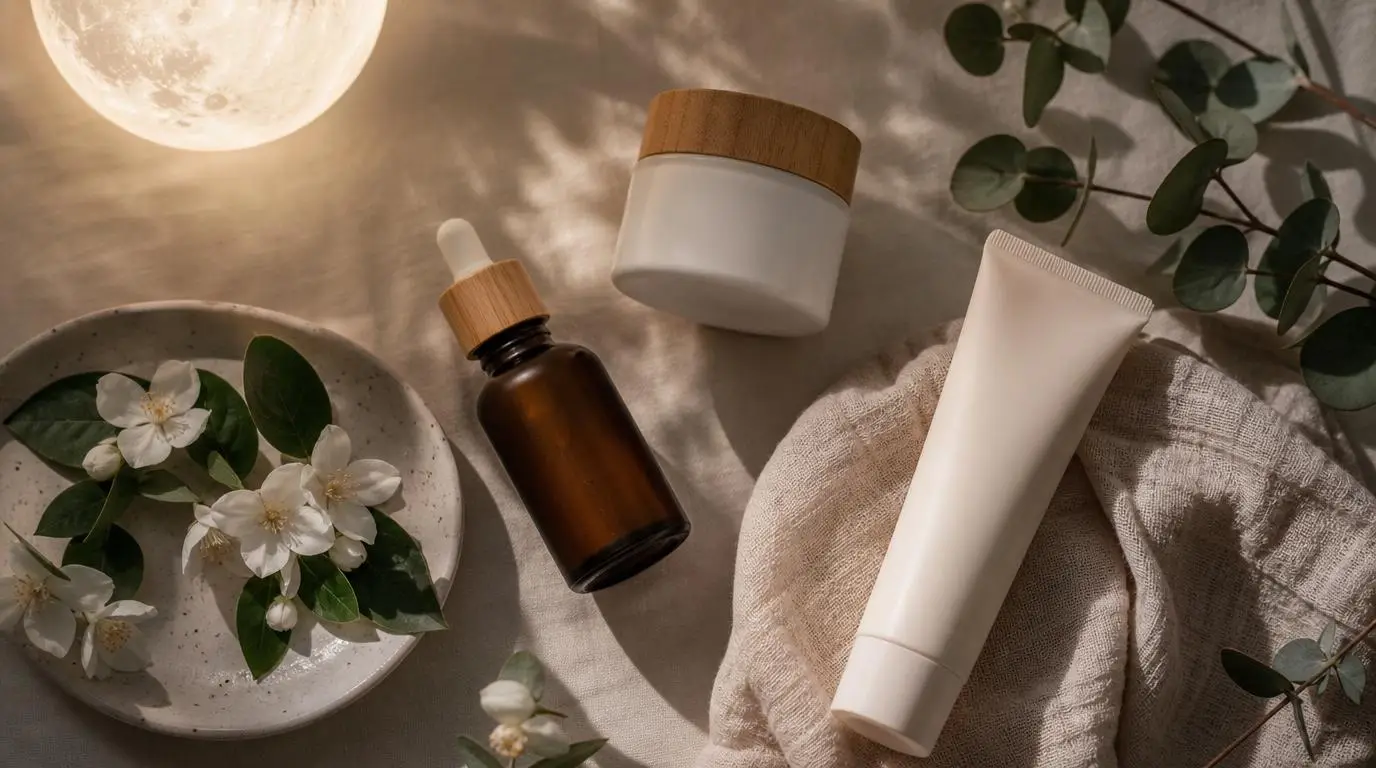
Your skin actually behaves differently at night than during the day — it loses more water, soaks up products more easily, and goes into repair mode while you sleep. That’s why a thoughtful nighttime routine is worth the eight minutes it takes, and why the order you apply your products genuinely matters.
Here’s the correct order to apply skincare at night, the simple science behind each step, and the vegan-friendly ingredients to know — without the marketing fluff.
The short answer: Cleanse → optional toner → water-based serum → eye cream → targeted treatment (like retinol) → moisturizer → optional facial oil. The rule of thumb is thinnest to thickest, water-based before oil-based.
Why Your Skin Behaves Differently at Night
Your skin runs on a body clock, just like the rest of you. While you sleep, three things shift:
- You lose more water through your skin. What dermatologists call transepidermal water loss peaks in the evening — meaning your skin is drier overnight than during the day, and an occlusive layer to seal in moisture has a clear job to do.
- Your skin absorbs more. The outer layer becomes more permeable at night, which is one reason your active ingredients work harder during the evening hours. (For the deeper science, see this review on circadian rhythm and skin.)
- Your skin repairs itself. Cell turnover and DNA repair from the day’s sun damage ramp up while you sleep — making nighttime the perfect window for targeted treatments.
This is also why retinoids belong at night. Most retinoids — including prescription tretinoin — break down in sunlight, becoming less effective and potentially more irritating. Applying them in the evening avoids that breakdown and lines up with your skin’s natural repair cycle.
The 7-Step Nighttime Routine, in Order
The principle is simple: thinnest to thickest, water-based before oil-based. Smaller molecules in lighter formulas need to penetrate first; heavier products go on last to lock everything in.
Step 1 — Cleanse
Start with a gentle, sulfate-free cleanser. If you wore SPF, makeup, or spent the day in pollution, do a double cleanse: an oil or balm cleanser first to dissolve oil-based residue, then a water-based cleanser to wash off what’s left.
Vegan tip: Skip cleansers with tallow, lanolin, or honey-derived ingredients. Look for plant oils (jojoba, sunflower, sweet almond) and amino-acid-based surfactants instead.
Step 2 — Toner or Essence (Optional)
Forget the alcoholic toners of the 1990s. Modern toners are hydrating treatments. A glycerin- or hyaluronic-acid-based essence on slightly damp skin sets up the serums that follow. Genuinely optional — skip it if it doesn’t add anything for you.
Step 3 — Water-Based Treatment Serum
This is where your most active, water-soluble serum goes. Pick one:
- Niacinamide (2–10%) — supports your skin barrier and helps with redness and uneven tone. A 2025 study showed it helps your skin hold onto water in dry conditions.
- Hyaluronic acid — pulls water into your skin. Best applied on damp skin, then sealed in afterward.
- Peptides — signaling molecules that may support collagen production over time.
- Azelaic acid (10–20%) — for redness, dark spots, and mild breakouts.
Step 4 — Eye Cream
The skin around your eyes is thinner and dries out faster than the rest of your face. Tap (don’t rub) a rice-grain-sized amount around the bone. Caffeine helps with puffiness; peptides help with fine lines.
Step 5 — Targeted Treatment (Usually a Retinoid)
This is the high-impact step. Pick one treatment per night so you don’t overload your skin:
- Retinol or retinaldehyde for anti-aging and texture (read our retinaldehyde vs retinol guide to choose between them)
- Bakuchiol as a plant-derived alternative if your skin is reactive
- Adapalene 0.1% (over the counter in the US) for acne and texture
Start at 2–3 nights per week and work your way up as your skin gets used to it. The “sandwich method” — moisturizer, then retinoid, then moisturizer — is gentler if your skin is sensitive.
Vegan tip: Most retinol and retinaldehyde you’ll find on the shelf is synthetic and vegan-friendly, but always scan the rest of the ingredient list for beeswax (cera alba) or shark-derived squalene. The vegan version of squalene is squalane from sugarcane.
Step 6 — Moisturizer
Seal everything in with a moisturizer that contains ceramides, cholesterol, and fatty acids — the three lipids your skin barrier is made of. A 2024 clinical trial showed that a ceramide-and-niacinamide moisturizer made acne treatment significantly more tolerable.
Step 7 — Facial Oil or Sleeping Mask (Optional)
If your skin is dry, mature, or recovering from active ingredients, a few drops of plant oil — squalane (sugarcane), rosehip, or jojoba — adds a final seal. Apply it after moisturizer, never instead of it. Oils don’t hydrate; they prevent your skin from losing the water you just added.
Active Ingredients at a Glance
| Ingredient | What it does | Pairs well with | Don’t combine with |
|---|---|---|---|
| Retinol / Retinaldehyde | Cell turnover, anti-aging | Niacinamide, ceramides | Strong AHAs the same night |
| Niacinamide | Barrier support, redness, oil control | Most actives | Very low-pH acids in the same step |
| Hyaluronic acid | Hydration | Ceramides, oils | Nothing notable |
| Glycolic / Lactic acid | Surface exfoliation | Hydrators | Retinol the same night |
| Salicylic acid | Pore decongestion | Niacinamide | Retinoid the same night (sensitive skin) |
| Bakuchiol | Gentler retinol alternative | Peptides, oils | Nothing notable |
| Ceramides | Barrier repair | Cholesterol, niacinamide | Nothing notable |
| Peptides | Signaling, repair | Niacinamide | Low-pH acids in the same step |
Vegan Ingredient Swaps Worth Knowing
A vegan night routine works exactly like a non-vegan one — same actives, same effects. The difference is what you avoid:
- Lanolin (sheep wool) → shea butter, mango butter, plant-derived squalane
- Beeswax (cera alba) → candelilla wax, sunflower wax, carnauba wax
- Honey, royal jelly → hyaluronic acid, glycerin, panthenol (vitamin B5)
- Squalene from shark → squalane from sugarcane or olive
- Bovine or marine collagen → peptides + niacinamide to support your own collagen
- Carmine (cochineal) → mostly in tinted products; just avoid
For a deeper dive into building a fully vegan routine, see our vegan skin care guide. And for verification, look for third-party stamps — Leaping Bunny, The Vegan Society, or PETA’s Cruelty-Free and Vegan logo — rather than just trusting “vegan” on the front of the bottle.
5 Common Mistakes to Avoid
1. Stacking too many actives in one night. Retinol + AHA + vitamin C all at once is a fast track to a damaged barrier. Alternate active nights with recovery nights.
2. Skipping moisturizer because your skin “feels oily.” Oily skin is often dehydrated skin overcompensating. A lightweight non-comedogenic moisturizer actually calms it down — see our non-comedogenic moisturizer guide.
3. Applying serums to bone-dry skin. Most water-based serums work better on damp skin. Cleanse, mist or pat with toner, then apply within 30 seconds.
4. Believing the routine has to be 10 steps. A great night routine can be three: cleanse, treat, moisturize. More products is not the same as better results.
5. No SPF in the morning. A nighttime routine with retinoids or acids without daily sunscreen is incomplete. Skipping SPF undoes most of the work.
Who Should Adjust the Routine
- Pregnant or breastfeeding: skip retinoids (retinol, retinaldehyde, tretinoin, adapalene) and high-strength salicylic acid. Bakuchiol, niacinamide, hyaluronic acid, azelaic acid, and ceramides are typically considered safer alternatives — but always check with your doctor.
- Sensitive or rosacea-prone skin: prioritize barrier support over actives. See our sensitive skin guide.
- Active eczema flare: pause all actives until your barrier is calm. Just cleanser plus a basic emollient.
- On prescription tretinoin or isotretinoin: don’t add OTC retinoids on top. Stick to your dermatologist’s plan.
- Teens under 18: a basic three-step routine (gentle cleanser, light moisturizer, morning SPF) is plenty. Anti-aging actives aren’t necessary yet.
Frequently Asked Questions
What’s the correct order of skincare at night?
Cleanser, optional toner, water-based serum, eye cream, targeted treatment (like retinol), moisturizer, and an optional facial oil. The principle is thinnest to thickest, water-based before oil-based — so smaller molecules can penetrate while heavier products seal everything in.
How long should I wait between steps?
About 30 to 60 seconds is enough for most products to absorb. Hydrating serums actually work better on slightly damp skin. For prescription retinoids, some dermatologists recommend waiting until skin is fully dry — about 10 to 20 minutes after cleansing — to reduce irritation.
Can I use vitamin C at night instead of in the morning?
Yes. Vitamin C is often recommended in the morning because it pairs nicely with sunscreen, but it works at night too. If you want to keep your morning routine minimal, applying L-ascorbic acid in the evening is fine — just don’t layer it with retinol the same night.
Do I need an eye cream, or is regular moisturizer enough?
For most people, a fragrance-free moisturizer applied gently around the eyes is enough. A dedicated eye cream is worth it if you have specific concerns — persistent puffiness, dark circles, or fine lines that benefit from peptide- or retinol-based products formulated for eyelid skin.
Why does my skin feel worse after starting a new night routine?
Initial worsening — sometimes called “skin purging” — can happen during the first 4 to 6 weeks of using retinoids or BHAs as cell turnover speeds up. True purging happens in your usual breakout zones. If irritation spreads to new areas, lasts beyond 8 weeks, or causes burning, stop and see a dermatologist.
How long until I see results?
Hydration improvements show up within days. Texture and tone changes from niacinamide or peptides typically take 4 to 8 weeks. Retinol results — fine lines, pigmentation, smoother texture — usually need 12 to 24 weeks of consistent use. Skin cell turnover takes about 28 days, so meaningful change is measured in months, not days.
Is a vegan night routine as effective as a conventional one?
Yes. How well a routine works depends on the active ingredients and the formulation, not whether the brand uses animal byproducts. Vegan formulas with niacinamide, ceramides, peptides, and synthetic retinoids deliver the same results — just verify vegan claims with Leaping Bunny, The Vegan Society, or PETA certification.
The Bottom Line
The best nighttime routine is the one you’ll actually do four or five nights a week — not the perfect 12-step regimen you abandon by Wednesday. Cleanse, treat, moisturize is your defensible baseline. Add a retinoid two or three nights per week once your barrier is comfortable. Layer in extras only if they solve a problem you actually have.
Sources & Further Reading
- American Academy of Dermatology — Skin Care Basics
- Circadian Rhythm and the Skin: A Review (J Clin Aesthet Dermatol, 2019)
- Niacinamide and stratum corneum hydration (Scientific Reports, 2025)
- Ceramide-and-niacinamide moisturizer in acne treatment (J Cosmet Dermatol, 2024)
- Tretinoin photostability under sun exposure (J Clin Aesthet Dermatol)
- Time-dependent variations of the skin barrier (J Invest Dermatol, 1998)
Last updated: May 6, 2026. This article is for informational purposes only and isn’t a substitute for professional dermatological advice — please check with your doctor before starting any new active ingredient, especially during pregnancy or breastfeeding.

